Photogrammetry
20 Jun 2026
Gaussian Splatting - the new visualization standard to come
Photogrammetry -> NeRF -> GaSp
Category
Photogrammetry
Time to read
5 minutes
Date
What Does GaSp/3DGS Mean to You?
Before we dive into details, what can Gaussian Splatting offer you and your business?
Stunning visualization of your production facility, with virtual tour capabilities
Visualization of your product with authentic reflections and actual lighting conditions preserved
Visualization of an apartment for sale or rent
Presentation of architectural gems and your region's historical heritage
Get in touch today to discover how to leverage this new technology!
Photogrammetry - The Current Standard
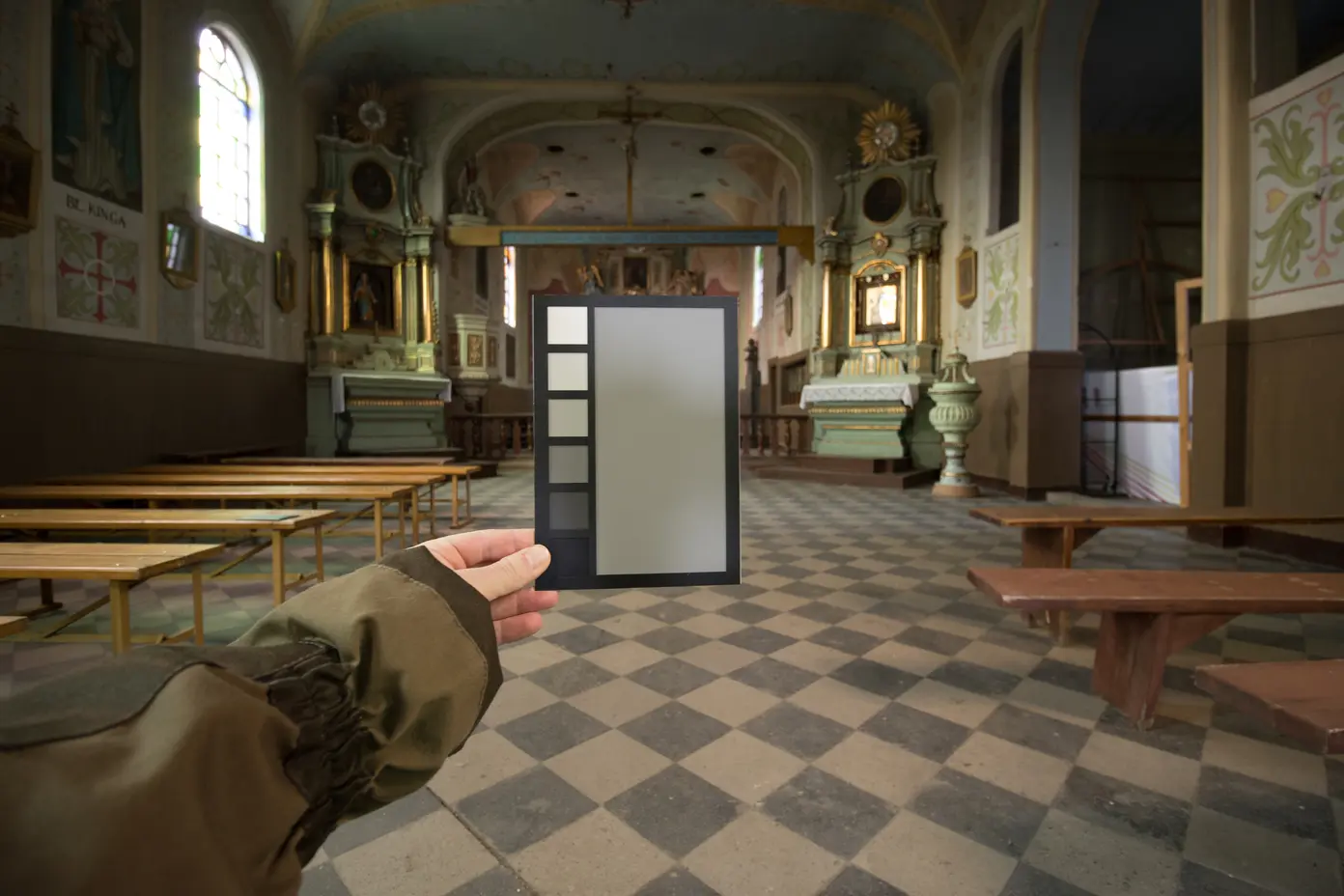
Three years ago, I was preparing a photoscan of a historic church in Trzęsówce, in the parish of St. Anne. Nearly 900 photos captured with a Canon 90D using a 10-18mm lens, color calibration, reconstruction, a 3D model with millions of vertices. Not as precise as laser scanning, but for visualization purposes and for a heritage conservator's review? Perfect.
What's Changed Since Then?
Everything. About three years ago, there was increasing buzz around NeRF technology - Neural Radiance Fields. Where photogrammetry struggled - reflections, specular highlights, whites, blacks, etc. NeRF excelled. The problem? Training a NeRF model was incredibly resource-intensive and required powerful graphics processing. Using this technology in real-time, let alone in a browser on a business laptop? Forget it.
Then, however, a derivative technology emerged, GaSp (or 3DGS), Gaussian Splatting. While based on similar principles, it did almost everything differently.
NeRF trained a neural network on the function f(x,y,z,θ,ϕ)→(RGB,σ), meaning position in space, viewing direction, density, color. The result is exceptionally high-quality visualization, but as I mentioned, the price is computational demands (the neural network is queried for hundreds of points for each ray cast by the camera [raytracing, let's not get into the weeds or we'll get lost]), making real-time application impractical.
In GaSp, conversely, the scene is represented by hundreds of thousands or millions of Gaussian ellipsoids.
Each Gaussian has:
XYZ position,
scale,
rotation,
color,
transparency,
parameters describing view-dependent properties (e.g., spherical harmonics).
In other words, there's no expensive neural network querying for each point along the ray.
Success?
Not quite - because while this solves some NeRF problems, new ones emerge, such as increased VRAM (graphics memory) demands, greater susceptibility to "floaters" (spurious artifacts suspended in space), or greater difficulty representing thin, delicate structures.
We also can't forget the common denominator of NeRF and GaSp - spatial representation isn't a solid mesh - it's volumetric visualization. A certain approximation of reality that, unlike photogrammetry, doesn't currently find application in metrology. At least not yet. But for visualization purposes? An excellent solution that beats many existing approaches.
GaSp / 3DGS is Still Evolving!
This isn't the end, increasingly, researchers and companies see the potential in Gaussian Splatting, and it's a rapidly developing technology. Already, there are methods for creating so-called LoD (Level of Detail), which allow you to place a 3DGS model on a website that, while comprising millions of ellipsoids, maintains smooth performance even on the most ordinary business laptop or smartphone.
Add to this the developing field of re-lighting, controlling the lighting of scenes created with GaSp / 3DGS technology and we have a revolution waiting in the wings for visualization.
Related articles
